
Service & Solidarity Spotlight: Years of Advocacy from SMART-TD and ATU Lead to Critical Bus Operator Safety Legislation
Working people across the United States regularly step up to help out our friends, neighbors and communities during these trying times. In our Service & Solidarity Spotlight series, we’ll showcase one of these stories every day. Here’s today’s story.
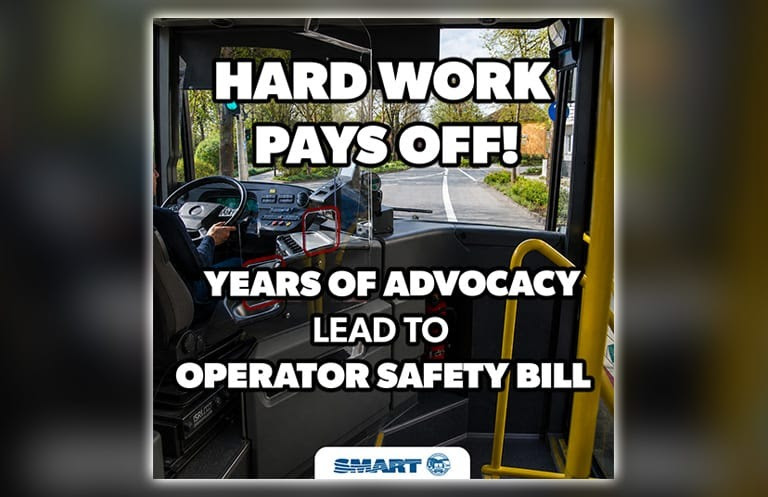
Following years of vocal advocacy by bus and transit members of the International Association of Sheet Metal, Air, Rail and Transportation Workers’ Transportation Division (SMART-TD) and the Amalgamated Transit Union (ATU), lawmakers have now introduced the bipartisan Bus Operator Safety and Security Act.
This legislation would require newly purchased, federally funded fixed-route buses—with a length of 30 feet or longer—to include protective barriers fully enclosing the operator’s workstation. The legislation is co-sponsored by Sens. Jack Reed (R.I.) and Josh Hawley (Mo.), and its House of Representatives companion bill was introduced by Reps. Shomari Figures (Ala.) and Jefferson Van Drew (N.J.). SMART-TD is hailing the tireless efforts of its Bus Department, National Legislative Department, and Bus and Transit Assault Prevention and Safety (BTAPS) Committee as key to helping this issue break through in the halls of Congress.
“Not a day goes by that I don’t hear about one of our members being shot, stabbed, spit on, verbally abused, and more. Every day, at least 42 transit workers are assaulted on U.S. transit systems,” said ATU International President John Costa in a press release. “The Bus Operator Safety and Security Act invests in critical transit security measures, including an enclosed driver workstation, to better protect our transit workers, riders, and communities. Operator safety is about public safety.”