
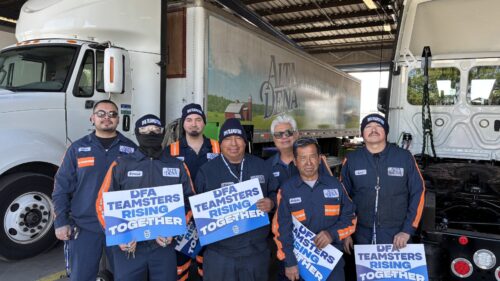
DFA Members Show Up for Teamsters Tuesday
Members at Dairy Farmers of America (DFA) plants all across the country wore their Teamsters beanies to work yesterday in a show of strength against the company. By May 5, 18 collective bargaining agreements for nearly 2,000 members at the dairy conglomerate will have expired. The Teamsters Union is demanding that DFA settle all outstanding […]
Read More....
Workers at Caesars Southern Indiana Casino Authorize Strike
(ELIZABETH, Ind.) More than 140 workers at Caesars Southern Indiana Hotel & Casino, represented by Teamsters Local 89 and Operating Engineers Local 399, have voted by a 98 percent margin to authorize a strike. The overwhelming vote is a direct response to management’s refusal to offer a fair contract. “Our members are united and ready […]
Read More....2025 APWU PAYROLL PROCESSING SCHEDULE
https://d1ocufyfjsc14h.cloudfront.net/sites/default/files/apwu_payroll_processing_schedule_final_.pdf2025 APWU PAYROLL PROCESSING SCHEDULE
Read More....
First Responders in Oregon Secure Teamsters Contract
(BEAVERTON, Ore.) – Emergency medical service dispatchers, technicians, and paramedics at American Medical Response (AMR) in Washington County represented by Teamsters Local 223 have overwhelmingly ratified their first collective bargaining agreement. The three-year agreement includes wage increases, signing bonuses, an eight percent 401(k) match, and improved vacation language. “This contract is the first labor agreement […]
Read More....
Vermont fire fighters play crucial role in election of mayor with IAFF support
Rutland, VT Local 2323’s endorsement of pro-labor, incumbent mayor Michael Doenges highlights how collaborative efforts, and strategic support can lead to political wins.
Read More....
IAM Reaches Strong Tentative Agreement with NCCC Rail Carriers
IAM District 19 has reached a tentative agreement covering approximately 4,900 freight rail members with the National Carriers’ Conference Committee (NCCC). The NCCC tentative agreement covers IAM members at BNSF, Norfolk Southern, Canadian National, Belt Railway, Terminal Rail, Consolidated Rail, Indiana Harbor Belt, New Orleans Public Belt, and Palmetto Railways. “Our membership asked us to
The post IAM Reaches Strong Tentative Agreement with NCCC Rail Carriers appeared first on IAMAW.

The ‘Hands Off Our Veterans’ Healthcare’ Fight Continues In 2025
March 24, 2025The ‘Hands O¥ Our Veterans’ Healthcare’
Fight Continues In 2025
magazineVeterans Resources
In the January/February 2025 Home Front article, we informed APWU veterans about the very serious consequences that Project 2025 will have on Veterans Affairs (VA) benefits, the quality healthcare services veterans receive, and the use of private contractors to process and evaluate their disability claims. We called it a “Code Red Alert” because Project 2025 plans to totally privatize our VA healthcare during President Trump’s second four-year term of office.
Project 2025 does not just affect VA healthcare benefits, it also affects five and 10-point Veterans’ Preference to regular federal government agency employment. So, while we are fighting to save our healthcare, we are also fighting to save our Veterans’ Preference jobs with the Postal Service, which are also threatened to be privatized under President Trump’s Project 2025 plans.
The plan to privatize VA healthcare has been a gradual, ongoing process ever since for-pro t private contractors started replacing VA Federal Government Management and highly trained VA employees more than 22 years ago. In fact, the private contracting of VA healthcare services has increased to such an extreme over the years, that currently over 70 percent of the more than $300 billion of the annual 2022, 2023, and 2024 VA healthcare budget went to private contractors, while only 27 percent went to regular VA federal government employee wages and VA healthcare.
Project 2025 tries to rationalize the privatization of VA healthcare. The most insulting excuse is that sending veterans to local private healthcare contractors would provide faster, top-quality healthcare services, and would reduce waiting times for medical appointments and claim decisions, more so than with fully staffed federal government medical professionals who are trained to serve and provide top-quality healthcare serves to veterans.
There is absolutely no proof that privatizing VA healthcare and increasing the wealth of those awarded private VA contracts would provide better or faster healthcare services than a fully staffed and trained federal agency that specializes in serving veterans. Has the increased privatization of VA healthcare services over the past 23 years reduced wait times for VA appointments? The answer is no! Wait times for a newly enrolled veteran’s first medical appointments are months long, which is a dramatic increase in waiting times for VA services.
A Look at VA Services Diminished by Privatization
While veteran suicide rates have increased, the process to access help from the privatized Veterans Suicide and Crisis Lifeline has gotten more challenging. When dialing 988 to access support, the automated process prompts veterans to dial 911 if it is an emergency, instead of connecting them directly to a real-life mentalhealth professional. This additional step a veteran must take adds another hurdle to access the care they need. Veterans Community Care and Emergency Medical Care services have separate billing systems controlled by private contractors, which seem to change like the weather. Additionally, for-profit private contractors oversee electronic VA enrollment and disability claims processing procedures.
So, APWU family, it is time to act against further privatization and degradation of VA services! Contact your congressional leaders and tell them to stop allowing private for-profit companies to enrich themselves at the expense of our veterans and the services they have earned. How are private contractors providing so-called quality healthcare while enriching themselves from the billions of dollars of veterans’ co-payments and the wage garnishments that cause financial hardship? Isn’t it obvious that privatization like Project 2025 demands has already been implemented at VA medical centers across the country? It is up to our APWU veteran family to stand up and fight back!
Our “Hands Off Veterans Healthcare” initiative and the struggle to save the Postal Service continues! ■
The ‘Hands O¥ Our Veterans’ Healthcare’
Fight Continues In 20250
Senate Introduces Resolution to Oppose USPS Privatization
March 31, 2025On March 27, a bipartisan group in the Senate introduced Senate Resolution (S. Res). 147, which “expresses the sense of the Senate that Congress should take all appropriate measures to ensure that the United States Postal Service remains an independent establishment of the Federal Government and is not subject to privatization.”
Legislative and Political
On March 27, a bipartisan group in the Senate introduced Senate Resolution (S. Res). 147, which “expresses the sense of the Senate that Congress should take all appropriate measures to ensure that the United States Postal Service remains an independent establishment of the Federal Government and is not subject to privatization.”
The bipartisan resolution, led by Senators Gary Peters (D-MI), Dan Sullivan (R-AK), Susan Collins (R-ME), Lisa Murkowski (R-AK), Maggie Hassan (D-NH), and Thom Tillis (R-NC), is crucial to demonstrating the strong support of the Senate for the public services that the Postal Service provides across the country, and the critical work that postal workers do every day to bind the nation together.
On Jan. 28, a group in the House of Representatives introduced their own similar bipartisan resolution, H. Res 70, which expresses the House’s support for taking all appropriate measures to ensure that the Postal Service is not subject to privatization. To date, this resolution has 180 co-sponsors.
“This strong showing of bipartisan support from both chambers of Congress confirms what we have always known, that the Post Office is our national treasure, providing invaluable services to the public,” said APWU President Mark Dimondstein. “The essential services we provide as postal workers cannot be replicated in the private sector, and any attempt to privatize the Postal Service would only increase costs and reduce services, which would be harmful to the people and businesses across the country.”
“The APWU extends our deepest appreciation to the senators leading the fight to protect the people’s Postal Service and push back against privatization attempts,” said Legislative and Political Director Judy Beard. “I am asking every APWU member, their families, and community allies to reach out to your Senators and encourage them to co-sponsor this resolution.”
Senate Introduces Resolution to Oppose USPS Privatization0
Read More....
What’s Next in 2025?
March 24, 2025Retirees Director Nancy Olumekor wonders What’s Next in 2025 for postal retirees.
magazineRetireesNancy Olumekor
With the recent passage of the Social Security Fairness Act, we have successfully navigated the repeal of the Windfall Elimination Provision (WEP) and Government Pension Offset (GPO). APWU members are now facing another life-changing decision with the announcement of the Postal Service’s Voluntary Early Retirement (VER) incentive offer. Before you decide if you should take the VER and the $15,000 incentive, consider the following questions:
Have you discussed your retirement plans with your family? Retirement is a family decision, not an individual decision.
Have you given due consideration to how this decision may impact you – are you financially prepared to retire or no longer work for the Postal Service? If you accept the VER or incentive, what bene ts do you keep or lose?
Have you made realistic calculations for how much money it will take to maintain your standard of living?
Do you understand the estimated amount of annuity you will receive each month from the Office of Personnel Management (OPM)? In addition to federal income taxes, what other deductions will reduce your monthly annuity?
Did you provide a survivor benefit? How much will that optional life insurance cost you?
Did you talk to the USPS retirement counselor and get all your questions answered?
If you are not satisfied with your answers to these questions, ask yourself, “Why not wait until I am ready to retire?” For more information, visit apwu.org/VER-2025
The Work to Protect Our Benefits Continues
Passage of the Social Security Fairness Act (H.R. 82) was a historic win for millions of Social Security bene ciaries; now, over two million public-sector retirees and their spouses will collect full Social Security bene ts. APWU President Mark Dimondstein, Legislative and Political Director Judy Beard, and I, Retirees Department Director Nancy Olumekor, were all in attendance on Jan. 5, 2025, when President Biden signed this historic bill into law at the White House, praising it as a “big deal” for the public servants “who dedicate their lives to their communities.” Those retirees now will receive an average $360 monthly increase in Social Security benefits in 2025, and a lump sum payment for benefits they would have earned in 2024. Unfortunately, there is no fixed timeline for when the benefits will be implemented by the Social Security Administration, and we anticipate delays ahead.
On Jan. 28, 2025, OPM announced: “During the first week of his administration, President Trump issued a number of directives concerning the federal workforce.” In its “Fork in the Road” notice to Federal Employees, the OPM stated, “At this time, we cannot give you full assurance regarding the certainty of your position or agency, but should your position be eliminated you will be treated with dignity and will be afforded the protections in place for such positions.” The announcement included an offer of a deferred resignation program to full-time federal employees, which would give employees an opportunity to resign while still receiving full pay and benefits through Sept. 30, 2025, provided they accepted the offer by Feb. 6, 2025. Postal workers were among those excluded from the program.
This is a direct attack on our union family in the AFGE. The time is now to join with all workers to protect our jobs and services. With a potential reduction in the federal workforce, we can expect longer waiting times for services at OPM, Social Security, Veterans Administration, and all other federal agencies. We must continue the fight against the threat of privatization of the Postal Service and seek congressional support for House Resolution (H. Res.) 70, which reaffirms our public Postal Service is essential and must remain in the hands of the people, not private interests. Retirees know that it is important for us to continue the fight. The struggle continues! ■
What’s Next in 2025?0
Read More....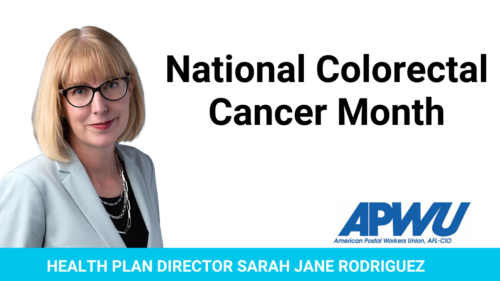
National Colorectal Cancer Month
March 24, 2025Health Plan Director Sarah Jane Rodriguez highlights the importance of getting colorectal cancer screenings.
magazineHealth PlanSarah Jane Rodriguez
March is National Colorectal Cancer Month, and I would like to highlight the importance of getting your colorectal cancer screenings. At my recent annual physical, my doctor said that I was a good candidate to use the Cologuard test. It was delivered to my doorstep and only took a few minutes to complete the test. Very convenient and easy!
What Is Colon Cancer?
Colon cancer is a growth of cells that begins in a part of the large intestine called the colon. The colon is the rst and longest part of the large intestine. The large intestine is the last part of the digestive system. The digestive system breaks down food for the body to use.
Colon cancer typically affects older adults, though it can happen at any age. It usually begins as small clumps of cells called polyps that form inside the colon. Polyps generally are not cancerous, but some can turn into colon cancers over time. Polyps don’t often cause symptoms. For this reason, doctors recommend regular screening tests to look for polyps in the colon. Finding and removing polyps helps prevent colon cancer.
Colon cancer is sometimes called colorectal cancer. This term combines colon cancer and rectal cancer, which begins in the rectum.
High Option and Consumer Driven Option members pay nothing for preventive colorectal cancer screenings when visiting an innetwork provider.
If a surgical procedure is needed, regular plan bene ts apply. Screening options for colorectal cancer include tests that look for signs of cancer in the stool and visual exams of the colon and rectum. Recommended and approved testing from the Centers for Disease Control and Prevention (CDC) and Food and Drug Administration (FDA) includes:
Colonoscopy
A colonoscopy cancer test is when a doctor uses a long, thin, flexible, lighted tube to check for polyps or cancer inside the rectum and the entire colon. During the test, the doctor can find and remove most polyps and some cancers.
Before the procedure you will need to bowel prep, which is a process to clean out the colon so the doctor can see inside clearly. The prep may include fasting and drinking a liquid laxative. Most people do not feel any pain during the tests. If nothing is found, you can generally go up to 10 years without another test. As always, please consult your physician to see if they recommend you undergo the procedure.
Stool DNA test (Cologuard)
Cologuard is an FDA-approved type of at-home colon cancer test. It is available by prescription, and is ideal for some people looking for an alternative to a colonoscopy. One advantage of Cologuard is that it does not require any special diets, bowel prep, laxatives, or enemas. The patient collects a stool sample at home and mails it to a lab for analysis. Cologuard is not suitable for everyone. Some people will need to follow it up with a colonoscopy. To qualify for Cologuard, you must be at least 45 and have no symptoms or family history of colon cancer.
Whether or not Cologuard is right for you, be sure to ask your doctor about getting tested for colorectal cancer.
I understand some might feel reluctant, but it is important to know that any minor discomfort or embarrassment from a colon cancer screening is only temporary, and early detection could save your life.
To find an in-network provider, please visit apwuhp.com and click “Find Care.”
For more information, please go tocdc.gov and cancer.org. ■
National Colorectal Cancer
Month0