
APWU

Defending APWU Veterans Harmed by the Current VA Crisis
May 20, 2025The Union Veterans Council, in partnership with APWU affiliate veteran leaders and veteran service organizations nationwide, will address the devastating impact of the Trump and Musk attacks on our veterans and their family members.
magazineVeterans Resources
In the March/April 2025 Home Front column, we informed APWU veteran members of the highly serious consequences that Project 2025 will have on Veterans’ Affairs (VA) benefits, the quality of healthcare services veterans receive, and the use of private contractors to process and evaluate their disability claims. Our “Hands Off Our Veterans’ Healthcare” fight continues in 2025.
Well, APWU Veterans, what was a warning last year has suddenly become a reality. Veterans nationwide are under attack. The Project 2025 plan to destroy Veterans Preference and to gut federal agencies – including the Postal Service and VA healthcare benefits, has begun. So, it’s time to do what military veterans always do when we are under attack, we fight back!
The Union Veterans Council, in partnership with APWU affiliate veteran leaders and veteran service organizations nationwide, will address the devastating impact of the Trump and Musk attacks on our veterans and their family members. With hundreds of thousands of veterans employed in the Federal workforce, and millions relying on VA Healthcare and Veterans Benefits services, it is critical that our APWU veteran leaders and veteran organizations nationwide are fully informed on these threats and equipped with the real facts to counter misinformation. Together, we will provide accurate, up-to-date information so that our veteran leaders and veteran organizations have the tools to confirm or rebut misleading claims. The goal is to inform, equip, and mobilize leaders with clear, verifiable facts about these attacks. We want veterans organizations to know they have a trusted partner in the labor movement, ensuring they are never caught off-guard by administrative rhetoric or policy changes.
“The Union Veterans Council AFL-CIO is prepared to lead the way in this major battle to save veterans’ rights and benefits, federal jobs, and top quality veterans’ healthcare, fully staffed by Federal Government employees,” said Union Veterans Council Director William Attig.
The Union Veterans Council and APWU veteran leaders must defend our veterans’ family during this major American crisis. Tell the truth about the Trump and Musk agendas: separate fact from fiction. Counter misinformation, identify false narratives, confirm or rebut claims, and provide veterans with trusted information. The personal human cost of these attacks, and how veterans’ organizations and union organizations can work together, are crucial in the battle to save our American democracy.
We are under attack through job cuts, veteran layoffs, political purges, hiring freezes, VA closures and more. VA privatization means outsourcing will lead to longer wait times, higher costs, and worse healthcare outcomes for veterans. The impact of cuts to Social Security, military disability and pension claims, as well as other earned federal government benefits that millions of veterans and family members rely on daily, will seriously damage their personal lives.
The Struggle Continues, Because When Our Union Veterans are Under Attack, We Stand Up, Fight Back! ■
STAND WITH VETERANS Unite for Veterans, Unite for America
Veteran jobs, earned benefits, and essential VA services are under attack.

Revealed: Musk Uses DOGE to Stifle Competition, Siphon Money into Own Pockets
May 20, 2025Our tax dollars should be used to better our communities. But at the Department of Government Efficiency, Elon Musk is allocating funds to stifle market competition in areas that were once used to help his companies thrive. Read more:
magazine
In his role chairing the Department of Government Efficiency (DOGE), Elon Musk has criticized excessive government spending and dependency. Ironically, he is one of the greatest beneficiaries of our tax dollars. Over the last 20 years, his businesses have received at least $38 billion in loans, subsidies, government contracts, and tax credits.
Our tax dollars should be used to better our communities. Musk using government loans and subsidies is not necessarily a bad thing – in fact, Tesla is an example of the success that can come from public investment in private companies. Tesla used government loans to make affordable electric vehicles, reducing carbon emissions to help our environment. But now Musk is advocating for cuts to the same departments that granted his companies contracts and strangling other businesses that could also help our communities and the environment. By gutting programs and agencies that helped his business empire succeed, he is eliminating access to assistance before his competitors can use it.
Musk is also abusing his position to influence government contracts in his favor. In March, The Washington Post reported on changes to a Biden-era program providing internet to rural communities. The program’s contract with Cajun Broadband to provide fast and reliable internet to 450,000 households in Louisiana has been put on hold after the Trump administration announced that it is redirecting grants from broadband to satellite companies, particularly Musk’s Starlink company.
DOGE cuts are harming our communities. Layoffs at the Food and Drug Administration will make our food supply chain less safe, and cuts to the National Institute of Health have slashed funding for cancer research. The unelected billionaire is recklessly putting our country at risk so that he can put money in his pockets.
Let’s fight back against the billionaire class and say, “Hands off our public services!” ■
Revealed: Musk Uses DOGE to Stifle Competition, Siphon Money into Own Pockets0
Read More....
Greenpeace Prepares International Lawsuit to Defend Freedom of Speech
May 20, 2025Greenpeace, an environmental advocacy organization, recently suffered a setback in its fight against Big Oil company Energy Transfer (ET), when a jury issued a $660 million award against the organization.
magazine
Greenpeace, an environmental advocacy organiza tion, recently suffered a setback in its fight against Big Oil company Energy Transfer (ET), when a jury issued a $660 million award against the organization. The lawsuit is a clear-cut example of how a Strategic Lawsuit Against Public Participation (SLAPP) is used against activists and non-profits that speak out against injustices, like the Dakota Access Pipeline (DAPL), by burying them in expensive, drawn-out legal battles so that they can no longer fight back.
“This case should alarm everyone, no matter their political inclinations,” said Sushma Raman, Greenpeace Fund Interim Executive Director. “It’s part of a renewed push by corporations to weaponize our courts to silence dissent. We should all be concerned about the future of the First Amendment… These rights are critical for any work toward ensuring justice – and that’s why we will continue fighting back together, in solidarity.”
Now, Greenpeace International is suing several ET entities involved in the DAPL dispute for all damages it has suffered because of ET’s unjust lawsuits and the prejudice displayed in North Dakota.
For example, ET’s key findings lacked evidence, evidence supporting Greenpeace was excluded, there was ongoing concern about the fairness and impartiality of the jury, and requests for a change in venue were denied.
Kristin Casper, Greenpeace’s general counsel said, “This isn’t just a fight for Greenpeace defendants: it’s a fight about the protection of fundamental rights for everyone. We are committed to our values, such as nonviolence, independence, and promotion of solutions. We won’t back down…This is the kind of fight that we were made for.”
Greenpeace Prepares International Lawsuit to Defend Freedom of Speech0
Read More....
Bill Restricting Federal and Postal Unions from Deducting Union Dues Moves Forward in Congress
May 20, 2025On March 18, the Paycheck Protection Act (H.R. 2174) was introduced in the House, which if passed, will prevent all federal and postal unions from deducting union dues from employee paychecks, thus weakening our collective bargaining power. Learn more:
magazineLegislative and Political
On March 18, 2025, three conservative lawmakers in the House of Representatives introduced the Paycheck Protection Act (H.R. 2174), which would restrict all federal and postal unions from deducting union dues from employee paychecks, if it becomes law. In addition to union dues, this bill aims to restrict deductions for “fees or political contributions,” which may mean many other deductions, such as the Committee on Political Action (COPA) and the Thrift Savings Plan (TSP).
The bill, introduced by Rep. Eric Burlison (RMO- 07) and cosponsored by Rep. Mary Miller (R-IL-15) and Rep. Nancy Mace (R-SC-01), was voted favorably out of the Committee on Oversight and Government Reform on March 25. Now, lawmakers can move this bill to the House floor for a vote, which has not yet been scheduled as of the publication of this issue of The American Postal Worker.
For years, voluntary payroll deductions have been used as an efficient and economical way for employees to pay certain bills. By targeting union dues, lawmakers are taking direct aim at labor unions’ self-funding. Ultimately, it would be harder for workers to pay their union dues, and therefore the union would have fewer resources to fight grievances and collectively bargain.
While lawmakers argue that this bill protects your freedom – in reality, union dues are completely voluntary and always authorized by postal and federal workers themselves. The so-called “Paycheck Protection Act” places unnecessary burdens on the APWU and could dismantle our union.
The APWU’s Legislative and Political Department is closely monitoring this bill and will continue to meet with lawmakers on Capitol Hill to fight against this bill moving any further, but we need your help. Contact your congressional representatives in the House and urge them to strongly oppose H.R. 2174, the Paycheck Protection Act! ■
Bill Restricting Federal and Postal Unions from Deducting Union Dues Moves Forward in Congress0
Read More....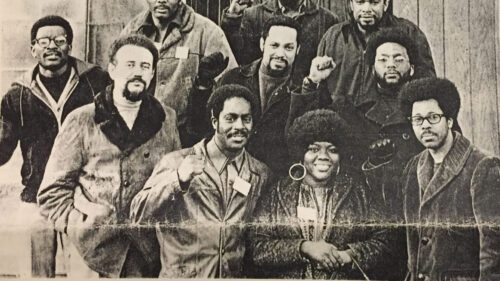
Looking Back: Black Workers Organize ‘Revolutionary Union Movement’
May 19, 2025This month in Labor History, we look back at the Dodge Revolutionary Union Movement of 1968 – when over 4,000 Black workers who were fed up with racist policies organized a two-day strike at Chrysler’s Hamtracmck plant to demand improvements for Black workers on the job and in their unions, spawning a revolutionary union movement across other auto plants in Greater Detroit.
magazineAPWU History
May 2, 1968 – Auto workers walked o the job at Chrysler’s Dodge manufacturing plant in Hamtramck, MI after the company implemented “speed-up” conditions that forced workers to increase output by nearly 40%. However, while white workers were prominently on the picket line, it was mainly Black men who were fi red for walking out, including General Gordon Baker.
Prior to 1960, white men had dominated the city’s auto industry, but increased demand led Chrysler to hire large groups of Black workers to fill the dangerous assembly lines. By 1968, a majority of the workforce of the Hamtramck plant was Black (70%), but most of the managers and union representatives were white – further underscoring the racism of the time.
Fed up with the company’s racist policies, including segregated lunchrooms, the union’s inaction to help fired Black workers, and lack of Black representation, Baker organized the Dodge Revolutionary Union Movement (DRUM) with two former classmates Luke Tripp and John Watson, from Wayne State University, to demand improvements for Black workers in the workplace and in their unions.
The founders of DRUM were no strangers to activism – they grew up in the Deep South and were familiar with the strategies of rural, southern militant organizing. In college, they formed a student-led civil rights group and protested police violence.
After Baker’s dismissal, he wrote a letter to the company declaring battle. DRUM held rallies for workers, students, and community members about racial justice and called for a series of wildcat strikes, which DRUM saw as a tool to address the grievances of Black workers. Only a year since the 1967 riots in Detroit, Black workers were frustrated by the limits on economic opportunities and their power within their unions.
On July 8, DRUM led nearly 4,000 Black workers o the job for a two-day strike at the same Hamtramck plant, preventing the production of 3,000 cars. None of the workers were fi red, and DRUM was thrown into the spotlight. They also ran an opposition slate during subsequent union elections.
By 1969, the “Revolutionary Union Movement” wildcat strikes spread to other auto plants in Greater Detroit, forming the Ford Revolutionary Union Movement and the Eldon Avenue Revolutionary Union Movement at the Chrysler Eldon Avenue plant, as well as outliers like UPS and healthcare workers.
The wildcat strikes from 1968-1969 had tremendous influence on Detroit’s industries and its unions, forcing the “Big 3” to make improvements to working conditions, addressing racial justice, improving seniority and grievance procedures, and helping Black workers gain more representation in local union positions. ■
Observing Juneteenth for Dignity and Equality
Read More....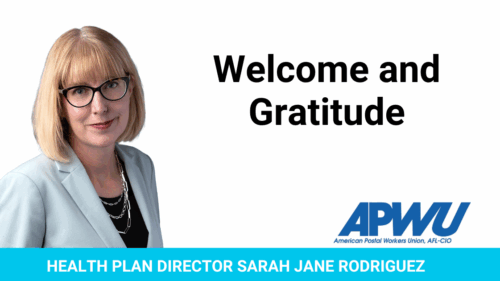
Welcome and Gratitude
May 19, 2025Health Plan Director Sarah J. Rodriguez expresses gratitude for members’ support of the APWU Health Plan, sharing excellent satisfactory rankings in payment accuracy, financial accuracy, and administrative accuracy.
magazineHealth PlanSarah Jane Rodriguez
Thank you for selecting the APWU Health Plan as your health insurance provider. We have designed a plan especially for YOU! We honor the opportunity to serve postal families. We not only pay claims, but we also provide a platform to collaborate and promote healthy lifestyles. This Open Season, the Health Plan enrolled over 2,500 new members! Today, we cover almost 174,000 lives. With the introduction of the Postal Service Health Benefits (PSHB) program, APWU members had many choices – thank you for trusting us. Your continued loyalty and new membership directly affect the union and our ability to organize. Union Proud, Say It Loud!
Our Commitment to You
In addition to strong benefits and affordable rates, the APWU Health Plan takes service and quality very seriously. Represented by the OPEIU Local 2 and SEIU 32BJ unions, our Customer Service team participates in ongoing training to effectively communicate the benefits of our plans. Our team excels at going the extra mile, with patience and empathy, to make sure you have a positive experience with us. If you have questions about your health plan, do not hesitate to call the Customer Service number indicated on the back of your Health Plan ID card.
High Option members, call 800-222-2798;
Consumer Driven Option members, call 855-808-3003.
Proven Excellence
In a recent independent audit, conducted by Mercer, the APWU Health Plan ranked one of the highest in PSHB in three categories: payment accuracy (99.18%), financial accuracy (99.63%) and administrative accuracy (100%).
The audit results surpassed the Office of Personnel Management (OPM) goal of 98%. With these scores, you can be con dent that you are enrolled in a plan that exceeds OPM quality standards. These high scores mean fewer errors, faster claims processing time, and greater peace of mind for you.
Your Voice Matters
As you embark on your first 100 days of coverage for the 2025 benefit year, let us know how we are doing! As our member base continues to grow, we want to check in with you to understand your experience. What works for you? What are some challenges? Please take a short survey, by visiting: hcsurvey.apwuhp.com. ■
Welcome and Gratitude0
Read More....Keep Calling Congress to Oppose Cuts to Postal and Federal Pensions
May 19, 2025In the late night hours of Sunday, May 18, 2025, the House Budget Committee voted by a margin of 17-16 to advance a bill that would give $4.5 trillion in tax cuts to the ultra-wealthy on the backs of the working class. Just two days prior, the same committee voted by a margin of 21-16 against advancing this bill with some committee members doing so in an attempt to inflict deeper spending cuts.
In the late night hours of Sunday, May 18, 2025, the House Budget Committee voted by a margin of 17-16 to advance a bill that would give $4.5 trillion in tax cuts to the ultra-wealthy on the backs of the working class. Just two days prior, the same committee voted by a margin of 21-16 against advancing this bill with some committee members doing so in an attempt to inflict deeper spending cuts. Remember that in order to pay for these massive tax cuts, many in Congress are looking to reduce government expenses, including our pensions.
After some changes were made over the weekend that affect postal and federal employee pensions, here are the direct attacks on the Federal Employees Retirement System (FERS) that remain in the bill:
Replacing the High-3 FERS annuity calculation with a High-5 calculation, resulting in a reduction in annuity payments
Eliminating the FERS Social Security supplement, which would deny workers who are eligible to retire the supplemental payments used to bridge the gap before their Social Security benefits begin at age 62
In the original version of the bill, there was a section to increase the mandatory FERS annuity contribution rate for all active employees to 4.4%, but this was eliminated from the current version. While it is good news that this section was removed, nothing is set in stone and our fight persists to protect current and future postal workers.
Thanks to the hard work of APWU members, as well as strong public outreach, many members of Congress on both sides of the aisle have now spoken out against cuts to our pensions. However, many senior leaders in Congress, and the White House, are actively working to pass this bill through the House of Representatives before Memorial Day.
There is still time to remove these FERS cuts. Because we don’t know what the final bill will include, now is the time to act! We encourage APWU members and supporters to call our Legislative Hotline at 844-402-1001 and urge your House representative to OPPOSE any cuts to federal and postal pensions!
Keep Calling Congress to Oppose Cuts to Postal and Federal PensionsBill to Give Major Tax Cuts to the Ultra Wealthy Moves Forward0
Read More....
Flip the Script on Aging
May 19, 2025Retirees Director Nancy Olumekor encourages retirees to honor Older Americans Month by flipping the script on aging – reframe our mindsets and focus on the positive aspects of growing older while fostering relationships with the community around us.
magazineRetireesNancy Olumekor
Every May, the Administration for Community Living, leads the nationwide observance of Older Americans Month. The 2025 theme, Flip the Script on Aging, focuses on transforming how society perceives, talks about, and approaches aging. We will challenge stereotypes and dispel misconceptions. This year, we honor older adults’ contributions, explore the many opportunities for staying active and engaged as we age, and highlight the opportunities for purpose, exploration, and connection that come with aging.
In reading an article by Joseph Claussen, titled “Flipping the Script on Aging” he recommends that we look at aging like a game where we level up every year. We can reframe our mindsets and focus on the positive aspects of growing older, such as maintaining a healthy diet and exercising routinely, which can help us age gracefully. We can also work to deepen our connections with family and friends and build new relationships. We should strive to communicate and resolve conflicts more effectively, and show compassion and empathy.
Claussen wrote, “By investing in our relationships, we can create a support network that helps us navigate life’s challenges and enriches our daily lives… We can identify our values and priorities, set meaningful goals, and work towards them with intention and purpose… We can embrace challenges as opportunities for learning and self improvement… we need to celebrate our accomplishments, no matter how small, and look for ways to build on them.”
Below are some practical ways to flip the script on aging:
Set goals for personal growth and celebrate when you achieve them;
Take on new challenges, whether it’s learning a new skill or trying a new hobby;
Connect with loved ones regularly and invest in your relationships;
Practice self-care and prioritize your physical and emotional well-being;
Embrace your wisdom and share it with others.
LifeCare Alliance of Central Ohio suggests another way to “Flip the Script” is by “Starting the Conversation,” to explore intergenerational differences and promote deep appreciation of others.
How to bring people together for meaningful conversations:
Reach out to your local senior center or local union and see if you can organize an afternoon of story sharing.
Contact your local union and see if they would like to host a “Senior Day.”
Visit an assisted living center and chat with residents in the common areas.
Volunteer to deliver Meals-on-Wheels with a young person and connect with the seniors you serve.
Share stories of older adults who aged gracefully following their retirement.
Ways to break the ice:
What was the happiest moment of your life?
Who has been the biggest influence on your life and what lessons did you learn from them?
What are you proudest of in your life – and why?
What was it like where you grew up?
What stories did your parents share with you about their childhood or upbringing? How did that make you feel?
By flipping the script on aging, we can improve our quality of life and promote a positive outlook on aging. Think of aging in terms of how it could enhance creativity, new experiences, and opportunities to contribute to or nd a new purpose.
Federal Income Tax Liability with Repeal of the Windfall Elimination Provision (WEP) and the Government Pension Off set (GPO)
With the repeal of the WEP/GPO penalty, many of you will notice an increase in your Social Security payments. The increased benefits could push you into a higher tax bracket with potential tax implications. The lumpsum retroactive payment could also push your income higher, leading to greater tax liability. Those impacted will have less than a year before these increased benefits impact your tax liabilities, meaning that benefits paid in 2025 will appear on the 2025 SSA-1099 form. Make sure you follow-up with your federal income tax preparer this year for your income tax liability going forward. ■
Flip the Script on Aging0
Read More....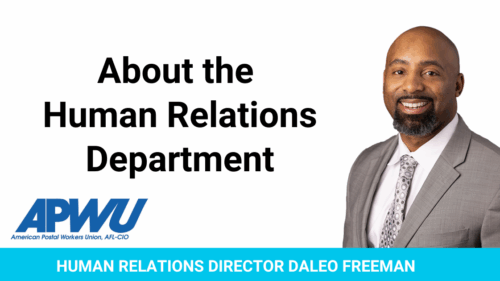
About the Human Relations Department
May 19, 2025Human Relations Director Daleo Freeman provides an overview of services offered by the Human Relations Department.
magazineHuman RelationsDaleo Freeman
There is more to being a progressive union than achieving and enforcing a contract — and that is where the Human Relations Department comes in. Our programs and benefits inspire members to become active participants of the APWU, and give them a sense of inclusion, contribution, and ownership.
Training
We have successfully trained over 5,500 members, activists, stewards, and officers.
This year, the Human Relations Department aims to continue training sessions for locals and states and provide a Regional Resource Assistant to assist locals and states with their issues.
Employee Assistance Program
The Employee Assistance Program (EAP) is a resource for postal employees and their family members designed to help them with on-the-job, personal, or family problems. EAP is a counseling and referral service staffed with mental health professionals. It is a formal, non-disciplinary program that is free and voluntary.
To learn more about EAP services, visit: apwu.org/eap
Veterans’ Rights and Benefits
The APWU continuously coordinates efforts to support union members and their loved ones who have, or who are actively serving in the military. We have started a coalition across the country to mobilize around the issues that affect our service members.
The APWU believes in a society where all members are treated equally, with respect and dignity. The struggle for equal rights, equal opportunity, and justice extends beyond the workplace into our neighborhoods and communities. It is a priority of the department to remain active around our civil rights.
In 2025, we will continue to strive for equality for all and to protect the rights and benefits of those we serve, mobilize and continue to secure assistance for all who are in need. For more information, visit: apwu.org/veterans
Postal Employee Relief Fund
The Postal Employees’ Relief Fund (PERF) exists to help active and retired postal employees – management and craft – whose homes are destroyed or left uninhabitable because of a natural disaster, displacing postal employees and their families for an extended period of time.
The fund provides small relief grants to help qualifying victims of such circumstances reestablish residences and help replenish necessities in the aftermath of a devastating loss.
For more information, visit: www.postalrelief.com
Equal Employment Opportunity Commission
In 2025, we will soon provide our members with much needed guidance on how the Equal Employment Opportunity Commission (EEOC) works, as well as a handbook for the EEOC process.
We know how tedious the process can be, so it is the intent of the Human Relations Department to provide an informative manual, formulated specifically by your union on the EEOC rules, process, and general guidelines.
At this time, we are not providing representation, but it is important that we provide a resource and tool that can be readily accessible.
Please remain informed of the upcoming issuance of the new EEOC booklet that will be shared with our members.
Your questions and concerns are essential. They help us understand your needs and shape the direction of our department. Please, don’t hesitate to ask. Your input is invaluable in guiding our efforts.
We encourage all locals to have someone in attendance for the upcoming Human Relations Assembly in Houston, TX from June 12-15. We will focus on all the subjects listed above and will provide extensive training sessions and presentations on subjects that will touch every member. To register, visit: apwu.org/events/2025- human-relations-assembly. Thank you! ■
About the Human Relations Department0
Read More....
APWU POWER: The Women’s Committee Within Our Union
May 19, 2025Research & Education Director Joyce B. Robinson provides a brief history of APWU POWER (Post Office Women for Equal Rights), and invites members to attend the APWU POWER 22nd Biennial National Convention taking place in August.
magazinePOWERResearch and EducationJoyce B. Robinson
APWU Post Office Women for Equal Rights (POWER) is the women’s committee within our union. POWER was founded in St. Louis, MO on April 28, 1979 and incorporated into the APWU National Constitution, (Article 13, Section 7), in Detroit, MI in August 1980. The APWU POWER Steering Committee consists of five coordinators, one from each region, who are elected during the Biennial National Convention and assist POWER committees at the local and state levels.
Why APWU POWER Is Still Necessary
In the United States, women make up nearly 47% of the workforce and hold approximately 45% of jobs at the USPS. Although women make up a larger percentage of the APWU membership, and thus pay more dues than men, they hold fewer elected offices at the local, state, and national levels. There are only 28 national officers that are women, compared to 55 that are men.
APWU POWER has assisted women in obtaining the knowledge and skills needed to level the playing field in our union and has opened doors to opportunities for women across the country through educational seminars, workshops, and regional conferences. As a result, POWER sisters have become actively involved in their local and state unions and the political process, contributing over $200,000 to the APWU’s non-partisan Committee on Political Action (COPA) fund to assist in protecting employment benefits, improving working conditions, and ensuring job security.
What About Community Involvement?
APWU POWER’s involvement in community activities includes:
Adopting postal union families left unhoused due to natural disasters.
Making annual monetary contributions to domestic violence agencies.
Contributing gift bags to the female troops, unable to travel home for the holidays.
Providing coats and clothing to the unhoused.
Donating books, toiletries, and more to schools, homeless shelters, and senior citizens.
Contributing to the Postal Employees Relief Fund (PERF) to aid postal families who are victims of natural disasters.
APWU POWER ‘Sisters Helping Sisters’ Fund
APWU POWER’s “Sisters Helping Sisters Fund” was established in 2005 to help women and children who were left unhoused following Hurricane Katrina. It was expanded in 2006 to give hope and encouragement to women and children fleeing domestic violence. Since its inception, the fund has donated over $100,000 to families, charities, and domestic violence agencies, including $25,000 to PERF. If you would like to donate to this worthy cause, make checks payable to “Sisters Helping Sisters” and mail them to Joyce B. Robinson, Director Research and Education, 1300 L St. NW, Washington, DC 20005.
Attend APWU POWER 22nd Biennial National Convention
When: Arrive at the hotel on Wednesday, August 6. Workshops begin on Thursday, August 7. There is no convention on Sunday.
Where: Sheraton New York Times Square Hotel, 811 7th Ave. 53rd St., New York, NY.
Call 1-888-627-7067 before the cut-off date of Friday, July 11, 2025, to secure the negotiated rate of $237 per night (single/double occupancy), plus 14.75% room tax, plus $3.50 per room night occupancy tax. Identify yourself as attending the POWER Convention.
Register Online: Delegates must register online at APWU POWER 22nd Biennial National Convention. The registration fee is $150.00 for delegates and guests and includes an Installation Dinner ticket and a T-shirt. To register a guest, contact Joyce B. Robinson at (202) 842-4225, prior to the Friday, July 25, 2025 deadline. The guest must attend with an APWU member.
For additional information, contact the Research and Education Department at (202) 842-4225.
APWU POWER: The Women’s Committee Within Our Union0
Read More....