
APWU

Organizing Is Not Passive: Why Union Building Means Reaching Out, Not Waiting Around
May 19, 2025“Organizing is about talking to people and building relationships. It is about having hard conversations and asking others to stand with you.” – Organizing Director Anna Smith encourages members to organize their non-member coworkers.
magazineOrganizationAnna Smith
When people think about union organizing, many might imagine a moment of inspiration, maybe a spark or some event that sets off a wave of collective action. But the truth is, organizing requires a lot of consistent and demanding work, and long-term commitments. Organizing requires setting goals and putting together needed steps to achieve those goals. Union organizing requires action, and if you are sitting around waiting for people to come to you, you are not organizing — you are hoping.
Don’t get me wrong, there is nothing wrong with hoping the non-members will come to you and ask how to join. Hope has its place, but not when it comes to organizing our non-members. Organizing our non-members cannot be about wishful thinking, but about each one of us taking action to build worker power. Organizing is about talking to people and building relationships. It is about having hard conversations and asking others to stand with you. Most importantly, it is about taking the initiative to build our union and worker power in our installations and communities.
For those who make the decision to stand with us, we have made joining very easy with the ability to join online. While the “online join” process does bring in thousands of our coworkers into the APWU, most people will not automatically join simply because they stumbled across the ability to join online. Most often, our coworkers will join because someone they trust and relate to asked them to and they felt invited to be a part of something. They might join because someone listened to their concerns and then asked them to take a stand.
That someone must be you!
If you care about changes in your workplace, if you are tired of being disrespected by management, if you are tired of management violating our collective bargaining agreement every day, then you have to be reaching out to non-members. You must make the first move, because most non-members… they will not be coming to you.
We all must have conversations with the non-members and ask them to stand with us and be a part of something bigger. We need to stop letting our nonmember coworkers come to work and feel like they work in a non-union environment. We need to be persistent about standing with APWU and being bold about it.
Organizing is a skill, and like everything we do, it gets easier the more we do it. The core principles of organizing never change; it is about having conversations, building trust, giving our coworkers a sense of solidarity, and moving together in the same direction, with similar goals – I do not know of anyone who does not want to secure livable wages, reasonable work hours and better working conditions.
As an organizer, you will have setbacks, there will be some coworkers who, no matter how many times you ask them to stand with you, will refuse, but that does not mean you stop asking. Be brave enough to ask someone to stand with you — and strong enough to keep asking until they do. No matter what, do not let any setback discourage you, because as an organizer you will have victories too, and those victories, the ones who say “yes” to standing with you, will be empowering.
So do not wait for the perfect moment to ask that nonmember coworker to stand with you. Do not wait for them to come to you. Start organizing now. Talk to your coworkers. Ask questions, listen, build trust, and ask them if they are ready to stand with you. When we stand together, we win. ■
Organizing Is Not Passive: Why Union Building Means Reaching Out, Not Waiting Around0
Read More....
Protecting Our Labor Union and the Public Postal Service
May 19, 2025Legislative & Political Director Judy Beard urges members to call on Congress to to continue to fight privatization, and informs readers about new anti-union bills to watch.
magazineLegislative and PoliticalJudy Beard
The threat of postal privatization has never been more real. From the report of an executive order that would absorb the USPS into the Commerce Department, to the Wells Fargo report highlighting the financial benefits of selling off the USPS to corporations, our public Postal Service is at a pivotal moment in the fight against privatization.
Amid these threats, we have engaged with lawmakers in a bipartisan fight to protect the independence of the Postal Service. With post offices and APWU members in every ZIP code across the country, we are building a strong coalition in Congress to send the message that the U.S. Mail is NOT for Sale.
On Jan. 28, 2025, a bipartisan group in the House of Representatives led by Representatives Lynch (D-MA-08), LaLota (R-NY-01), Connolly (D-VA-11), and Garbarino (R-NY-02) introduced House Resolution (H.Res.) 70, which expresses the “sense of the House of Representatives that Congress should take all appropriate measures to ensure that the United States Postal Service remains an independent establishment of the Federal Government and is not subject to privatization.” At the time this issue of The American Postal Worker went to press, H. Res 70 had 202 cosponsors.
On March 27, a bipartisan group in the Senate, led by Senators Gary Peters (D-MI), Dan Sullivan (R-AK), Susan Collins (R-ME), Lisa Murkowski (R-AK), Maggie Hassan (D-NH), and Thom Tillis (R-NC), introduced Senate Resolution (S.Res.) 147, which serves as the companion resolution to H.Res 70. At the time this magazine was sent to press, S.Res 147 had seven cosponsors.
While resolutions are not binding like laws, they help us gain congressional support for the issues that most matter to us as postal workers and retirees. Millions of Americans rely on the Postal Service and members of Congress must be reminded that our work has value.
For ways you can take action to protect our public Postal Service, visit apwu.org/action.
Anti-Union Bills to Watch
On March 25, the House Committee on Oversight and Government Reform advanced several anti-union bills out of committee, including:
Protecting Taxpayers’ Wallets Act (H.R. 1210): This bill would charge federal unions for official time (“union time”) and for the use of agency resources.
Preserving Presidential Management Authority Act (H.R. 2249): This bill would give the U.S. president the ability to negotiate or terminate federal union collective bargaining agreements (CBAs).
The Paycheck Protection Act (H.R. 2174): This bill would restrict all federal and postal unions from deducting dues from employee paychecks. In addition to union dues, this bill would restrict deductions for “fees or political contributions,” which may mean all other deductions, such as the APWU Committee on Political Action (COPA) and the Thrift Savings Plan (TSP).
The Paycheck Protection Act specifically calls out postal unions in the bill text and would have devastating impacts on our union if Congress passes the bill and it gets signed into law. The Legislative Department is closely monitoring H.R. 2174, and we are meeting with both Republicans and Democrats on Capitol Hill to fight against this bill moving forward. ■
Anti-Union Bills: APWU Solidarity Actions
Protecting Our Labor Union and the Public Postal Service0
Read More....
Negotiations Update Support Services (May 2025)
May 19, 2025Support Services Director Arrion Brown provides an update on the current and recently completed negotiations for workers covered in the Support Services Division.
magazineSupport Services DivisionArrion Brown
Greetings Support Services Division members, I hope that you are enjoying the early days of summer. The Support Services Division has been hard at work this year continuing contract negotiations on multiple collective bargaining agreements. For general information, the Support Services Division represents and negotiates for 13 current and prospective collective bargaining agreements. Below is an update on our current and recently completed negotiations.
We are proud to say that one of our newest units of 10 Roads Express drivers based in Richmond, VA ratified their first collective bargaining agreement on Feb. 24, 2025. The workers organized and fought a valiant fight against their company to achieve collective bargaining. The drivers were very proud to ratify their first contract that secures bank holidays, gives them job bidding and bumping rights by seniority, gives them the rights to the grievance arbitration process to settle disputes with their employer, and offers protection against subcontracting.
One of our newer units of 10 Roads Express drivers, based in Capitol Heights, MD, has also recently achieved a tentative agreement with the company. The Capitol Heights agreement is very similar to the Richmond agreements, but the Capitol Heights drivers did hold out a little longer to achieve a few additional contractual demands. We were not able to achieve those demands, but we were proud to stand with and represent them as we fought for them.
The drivers of the Great Lakes Area Mail Haulers recently came to a tentative agreement with B&B Trucking, Inc. based in Kalamazoo, MI. These negotiations were very difficult. The company resisted improvements that the employees deserved. A significant improvement we won was an increase in hourly wages for drivers who perform freight work. B&B Trucking historically has been a mail-haul company that did very little freight work. Although the collective bargaining agreement with B&B has a wage chart for freight work, increases in that wage chart had not been negotiated since 2017. The union had concentrated on other issues, since there was either no freight or very little freight work done. However, since 2024, there has been a notable increase in freight work. The tentative agreement is in the process of being sent out for ratification by the members.
We are still in negotiations for the APWU and USPS agreement. While negotiations have slowed on this agreement, negotiating for Article 40 Operating Services and Article 41 Material Support Crafts has ended. As usual, management has refused to agree to changes for these two craft articles of the agreement. The employees under these two articles will benefit from the broader economic improvements of the agreement. It is very disappointing that, in yet another round of negotiations, management has refused to agree to minor changes in these two articles that would give them the same protections that are offered to other craft articles in the agreement. We will strategize for the next round of negotiations to continue our efforts to bring the Support Services crafts up to the same standards as the Clerk, Motor Vehicle, and Maintenance crafts.
We continue to negotiate the first successor agreement for the Humans Resources Shared Services Center (HRSSC) bargaining unit. At the time this issue of The American Postal Worker went to press, we are very close to a tentative agreement. There were only a few changes the bargaining committee proposed for this round of negotiations. We have met with management numerous times to come to bargaining agreements and have been satisfied with our progress.
Finally, we had our opening day of negotiations for the Information Technology and Accounting Services (IT/ AS) sector on March 4, 2025. We passed several proposals to management on changes we want. Management was very receptive and asked more questions than they have asked in opening sessions for other agreements. That was a good sign. ■
Negotiations Update (May 2025)0
Read More....
It Is Always About the Work
May 19, 2025In the ever-expanding world of postal words and jargon, ‘RTO’ and ‘LTO’ are recent additions you may see as a postal worker. These stand for Regional Transportation Optimization (RTO) and Local Transportation Optimization (LTO).” MVS Director Michael Foster explains these acronyms in-depth and how they impact the job.
magazineMVS DivisionMichael O. Foster
One of the primary purposes of the trade union movement is to nd work for its members. While unions constantly advocate to improve social injustices, equality, and fairness for their members and society as a whole, it is always about getting work, finding work, and keeping members gainfully employed. As the USPS drastically reduces its workforce, requiring fewer employees to do the same – or more – work in attempts to improve its bottom line, these management tactics and strategies will often have crafts and unions feeling the need to defend and protect their work.
Dispatch Coordinator Step 4
The Clerk Division and the USPS recently held national level arbitration hearings on the creation and assignment of the Dispatch Coordinator position to the MVS Craft. Although the MVS Division has also filed national disputes on the creation of this position and the siphoning of other MVS Craft duties, we still believe this is an MVS position. Please review the job descriptions and qualification standards of this position in your facility to determine if crossing-craft or occupation-group violations are occurring and contact your National Business Agent (NBA) to file the appropriate local grievance.
USPS Acronyms
In the ever-expanding world of postal words and jargon, “RTO” and “LTO” are recent additions you may see. These stand for Regional Transportation Optimization (RTO) and Local Transportation Optimization (LTO). RTO replaced LTO. These are part of the Delivering for America (DFA) plan and USPS efforts to reduce transportation costs and find other savings.
The MVS Craft must continue to monitor and protect the assignment of the transportation of mail in bulk quantities to any category of postal employees other than Motor Vehicle Service employees.
LTO is a part of the DFA plan to save the USPS money by eliminating or reducing transportation costs. This began as a pilot program in a few sites in 2024 when the Postal Service eliminated all afternoon trips outside of a 25 or 50 mile radius from an LTO site, meaning that there would no longer be a closeout trip to pick up that day’s mail from those offices, and that mail would be collected the following morning, thus adding an additional day for delivery. In most cases, the pilot program sites where this change occurred were being served by a Highway Contract Route (HCR) supplier.
RTO is the evolution of the Postal Service’s attempts to further reduce transportation costs for the transportation of mail. “Regional” is the key difference, as this evolution now limits the transportation of mail to one trip per day for offices outside of a 25 or 50 mile radius from an RTO site. This has potential for a much larger impact on, not just the delivery of mail, but also PVS duty assignments, due to the elimination of those afternoon closeout PVS trips, as not all PVS operations are within the 25 or 50 mile radius of an RTO. This change to RTO will most likely trigger management to attempt to make changes to all PVS duty assignments and attempt to repost them in accordance with Article 39.2.A.6 bidding procedures.
However, if unimpacted duty assignments are reposted due to a zero base, other audits, or any other administrative reasons, it would be in violation of the APWU/USPS Step 4 settlement for USPS Case# Q10C-4Q-C 14256865/ APWU# HQTV 20140505, signed and dated on Sept. 30, 2015. This language is also contained in the Joint Contract Interpretation Manual (JCIM) questions and answers in Article 39, question #78. According to Article 39.2.A.6, only the union can request a yearly, or bi-yearly bid.
Voluntary Early Retirement
Of the more than 5,000 MVS Craft employees eligible for the Voluntary Early Retirement (VER) incentive, approximately 550 MVS employees have accepted the offer. The officers of the APWU Motor Vehicle Craft wish you a long and happy retirement. ■
It Is Always About the Work0
Read More....
2025 Maintenance Division All-Craft Conference
May 19, 2025Maintenance Craft Director Idowu Balogun highlights the upcoming APWU All-Craft Conference and Bulk Mail Center Conference in October, discusses revisions to the TL-5 MS-47 Handbook, and a planned maintenance operation pilot program.
magazineMaintenance DivisionIdowu Balogun
The 2025 All-Craft Conference will be held in Las Vegas, NV on Oct. 6-8, 2025, followed by the Bulk Mail Center (BMC) Conference on Oct. 9, 2025. We will offer two training courses at the conference: Line H/Eagle Clean, and Article 32 Maintenance Subcontracting, presented by National Business Agents (NBAs). Preparation is already underway for the Maintenance Division Conference book and training materials for all attendees.
Eagle Clean is the postal program that has custodians in the field using Mobile Delivery Device (MDD) scanners in place of a hard copy PS Form 4776 – Preventative Custodial Maintenance Route to record daily tasks. The training will cover:
The genesis of the program from pilot to implementation;
What the scanner and screens look like and require; and
The various reports that can be requested and how to analyze those reports.
Maintenance subcontracting will cover Articles 19 (Administrative Support Manual) and 32 (Subcontracting) and how they tie into defending bargaining unit work from being outsourced to contractors. The training will also cover several national level arbitration decisions that control the subcontracting process from beginning to end.
Another TL-5 MS-47 Handbook Revision
On March 4, 2025, the Postal Service notified the APWU of additional revisions to the TL-5 MS-47 Handbook (Facility Cleaning). Once again, the Postal Service unilaterally imposed changes to the previously negotiated and agreed upon handbook language. According to the notification, the latest revisions “are intended to improve the overall clarity of the handbook and make information and procedures easier to locate. Additionally, changes were made to include necessary safety information.” We are currently in the process of reviewing the latest revisions and have already requested a formal meeting with the Postal Service to discuss the changes. We will continue to fight to maintain the rights that we successfully negotiated into the handbook.
Another Field Maintenance Operation Pilot Program Rolling Out
The Postal Service recently notified the APWU of their plans to test a work order ticketing system application in the Facilities Management Organization (FMO) to enhance the visibility of Area Maintenance Technician (AMT) work orders in the system. Currently, the FMO uses a unique system to enter and track work orders assigned under the FMO and facilities. However, there is very limited communication between the AMT and the maintenance supervisor on how a work order is required. This process results in limited visibility for Postal Service management to track the progress of maintenance requests. In an effort to improve the visibility of maintenance requests from submission to completion, the subject test will automate the submission of the PS Form 4805 – Maintenance Work Order Request, from a hard copy paper form requiring manual entry, to an electronic request (“Help Ticket”) that is entered directly into a web-based platform by the requester and displayed immediately to the AMT’s, thereby removing the need to be given a piece of paper by the supervisor.
The pilot test is scheduled to begin in the WestPac Area starting with California 4 and Arizona and New Mexico districts. The testing will last for 180 days, and it is anticipated that testing will be expanded to additional districts during the 180-day test period. The districts and associated time periods will be provided in advance.
The Maintenance Division continues to have ongoing meetings about FMO-related issues and is keeping a close eye on this new pilot program. We have expressed our concerns about potential violations of Articles 1.6 and 7. Please contact your NBA(s) to provide feedback if you are part of this pilot program. ■
2025 Maintenance Division All-Craft Conference0
Read More....
Clerk Division Updates
May 19, 2025Clerk Craft Director Lamont Brooks discusses three recently arbitrated issues and the Step 4 Settlement award on the work jurisdiction of Time and Attendance Collections.
magazineClerk Division Lamont Brooks
The Clerk Division has recently arbitrated three important issues at the national level:
The Dispatch Coordinator position, created by the Postal Service and originally assigned to the Clerk Craft, was later reassigned to the Motor Vehicle Craft. The Clerk Division firmly believes that the duties of this position are traditional clerk duties.
The Postal Service’s continued violation of Article 1.5 and Memorandum of Understandings (MOUs) related to the performance of non-managerial, non-supervisory work that should be assigned to the Clerk Craft. An interpretive issue in the 2018 RI-399 Update MOU concerning when it is proper to reassign work from one craft to another.
Step 4 Settlement – Time and Attendance Collection
Section 2 of the Step 4 settlement on Time and Attendance Collection (TACS), dated Sept. 5, 2018, states, in part:
d) Effective with the signing of this agreement, TACS duties may be included by local management in the Lead Clerk duty assignment postings for those duty assignments properly designated to perform the Lead Clerk Clock Office Role in TACS.
e) In facilities with Lead Clerks in duty assignments previously posted and awarded, who are currently performing TACS duties or that TACS duties were annotated on the bid posting, they will be grandfathered into this Agreement. If not previously provided, they will receive the required training, course #31267-01.
f) In facilities with Lead Clerks in duty assignments previously posted and awarded, and there are no Lead Clerks currently performing the TACS duties, the senior Lead Clerk in the facility will receive the required training, course #31267-01, and be assigned to perform the TACS duties. The parties at the local level may mutually agree to an alternative Lead Clerk in the facility to be trained/assigned in lieu of the senior Lead Clerk.
g) In facilities where there are multiple Lead Clerks, those Lead Clerks who have not been assigned timekeeping duties, are not required to receive the above referenced training. However, it is recommended they receive LMS Course #10025624, Lead Clerk Overview Training
TACS is clerk work. That is non-negotiable. Don’t let management perform our work. If the Lead Clerk is absent or on leave, Article 25 applies when assigning Lead Clerk duties.
Article 25, Section 4 of the Collective Bargaining Agreement between the APWU and USPS states:
Section 4. Higher-Level Details
Detailing of employees to higher-level bargaining unit work in each craft shall be from those eligible, qualified and available employees in each craft in the immediate work area in which the temporarily vacant higher-level position exists. However, for details of an anticipated duration of one (1) week (five (5) working days within seven (7) calendar days) or longer to those higher-level craft positions enumerated in the craft Articles of this Agreement as being permanently filled on the basis of promotion of the senior qualified employee, the senior, qualified, eligible, available employee in the immediate work area in which the temporarily vacant higher-level position exists shall be selected.
Clerk Division Updates0
Read More....Bill to Give Major Tax Cuts to the Ultra Wealthy Stalled in Committee
May 17, 2025Keep Calling Congress to Oppose Cuts to Postal and Federal Pensions
On May 16, 2025, the House Budget Committee voted by a margin of 21-16 against advancing a bill that would give $4.5 trillion in tax cuts to the ultra wealthy on the backs of the working class. This rejection will likely delay the process and we will continue to fight to change the bill before it gets another vote.
Unfortunately, some of the committee members who opposed the bill did so in an attempt to inflict more spending cuts. Remember that in order to pay for these massive tax cuts, Congress has opted to reduce government expenses, including our pensions. Within this tax cut bill there are direct attacks on the Federal Employees Retirement System (FERS), including:
Replacing the High-3 FERS annuity calculation with a High-5 calculation, resulting in a reduction in annuity payments
Eliminating the FERS Social Security supplement, which would deny workers who are eligible to retire the supplemental payments used to bridge the gap before their Social Security benefits begin at age 62
Increasing the mandatory FERS annuity contribution rate for all active employees to 4.4%
Members of Congress, on both sides of the aisle, have spoken out against cuts to our pensions. However, many senior leaders in Congress, and the White House, are actively working to convince members to reconsider their opposition to the bill, and to pass it through the House of Representatives before Memorial Day.
Because we don’t know what the final bill will include, now is the time to act! We encourage APWU members and supporters to call our Legislative Hotline at 844-402-1001 and urge your House representative to OPPOSE any cuts to federal and postal pensions!
Keep Calling Congress to Oppose Cuts to Postal and Federal PensionsKeep Calling Congress to Oppose Cuts to Postal and Federal PensionsKeep Calling Congress to Oppose Cuts to Postal and Federal Pensions0
Read More....Bill to Give Major Tax Cuts to the Ultra Wealthy Stalls in Committee
May 17, 2025Keep Calling Congress to Oppose Cuts to Postal and Federal Pensions
On May 16, 2025, the House Budget Committee voted by a margin of 21-16 against advancing a bill that would give $4.5 trillion in tax cuts to the ultra wealthy on the backs of the working class. This rejection will likely delay the process and we will continue to fight to change the bill before it gets another vote.
Unfortunately, some of the committee members who opposed the bill did so in an attempt to inflict more spending cuts. Remember that in order to pay for these massive tax cuts, Congress has opted to reduce government expenses, including our pensions. Within this tax cut bill there are direct attacks on the Federal Employees Retirement System (FERS), including:
Replacing the High-3 FERS annuity calculation with a High-5 calculation, resulting in a reduction in annuity payments
Eliminating the FERS Social Security supplement, which would deny workers who are eligible to retire the supplemental payments used to bridge the gap before their Social Security benefits begin at age 62
Increasing the mandatory FERS annuity contribution rate for all active employees to 4.4%
Members of Congress, on both sides of the aisle, have spoken out against cuts to our pensions. However, many senior leaders in Congress, and the White House, are actively working to convince members to reconsider their opposition to the bill, and to pass it through the House of Representatives before Memorial Day.
Because we don’t know what the final bill will include, now is the time to act! We encourage APWU members and supporters to call our Legislative Hotline at 844-402-1001 and urge your House representative to OPPOSE any cuts to federal and postal pensions!
Keep Calling Congress to Oppose Cuts to Postal and Federal PensionsKeep Calling Congress to Oppose Cuts to Postal and Federal PensionsKeep Calling Congress to Oppose Cuts to Postal and Federal Pensions0
Read More....FERS, CSRS & CSRS Offset Retirement Planning Seminar on ZOOM
The APWU Retiree’s Department Presents “FERS, CSRS & CSRS Offset Retirement Planning Seminar on ZOOM”
Saturday, May 31, 2025, at 12:00pm, Eastern Standard Time (EST)
SPECIAL NOTES:
1-Participants must be an APWU member.
2-Participants cannot register with a USPS email address, i.e., @usps.gov.
3-Each participant must register individually and not as a group.
4-Participants can not attend this training on the Postal Service time clock.
After registering, you will receive a confirmation email to join the meeting.
May 31, 2025 – 12:00PMZoomRegister Here
NationalNoNo2025-05-31 00:00:00Register in advance at: https://us02web.zoom.us/meeting/register/XRVg7blWTUW58ofwgIe97wThe APWU Retiree’s Department Presents “FERS, CSRS & CSRS Offset Retirement Planning Seminar on ZOOM”00
How to Use a PS Form 4707 to Enforce Workplace Safety
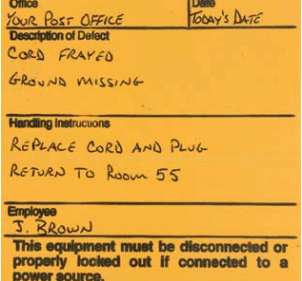
May 15, 2025The Industrial Relations Department shares information on when and how to use a PS Form 4707 – Out of Order notice, and why it is essential to red-tag damaged equipment:
magazineSpeak Up for Safe Jobs
The PS Form 4707 – Out of Order notice is a critical tool for enforcing workplace safety, operational efficiency, and equipment integrity. Many times, Postal Service management will allow damaged equipment, that should be taken out of service after an employee fills out and submits a PS Form 4707, to continue to be used on the workroom floor, creating safety hazards.
Postal workers should use the PS Form 4707 to report and tag defective equipment as “Out of Order” when equipment is found to be defective. It should be removed from service immediately, tagged with PS Form 4707, and taken to be repaired or placed in an area designated for troubled equipment. This ensures that the equipment is fixed before it goes back into service, creating a safe workplace environment for postal workers.
Below are some of the reasons why proper use of the PS Form 4707 is essential:
Use PS Form 4707 to Report Damaged Equipment for:
Safety Compliance – Reporting damaged equipment with a PS Form 4707 helps prevent accidents, injuries, or further damage by ensuring that employees are aware of malfunctioning or hazardous machinery and management can begin the work to fix or replace it.
Operational Efficiency – Identifying and tagging broken equipment helps maintenance teams prioritize repairs, reducing downtime and improving work ow. If the damaged equipment cannot be repaired locally, it is sent to a regional facility for repair. For example, damaged equipment in the Southern Region must go to Atlanta, GA for repair.
Regulatory and Policy Adherence – The USPS follows strict safety and maintenance regulations. Properly using a PS Form 4707 enforces compliance with internal policies and external safety regulations.
Accountability and Documentation – This form provides a record of equipment issues, which helps track maintenance history, identify recurring problems, and support necessary repairs or replacements.
Employees Should Not Remove a PS Form 4707 Red Tag. It is Necessary to:
Prevent Unauthorized Use – The red tag indicates that equipment is unsafe or non-operational. Removing it without proper authorization can lead to injuries or further damage.
Ensure Proper Repairs – The tag remains in place until the maintenance team has assessed and repaired the issue. Premature removal could result in equipment being used before it is safe.
Comply with Policy – USPS policies require damaged equipment to be properly tagged and assessed before returning to service. Removing a PS Form 4707 red tag without proper clearance violates these policies.
Prevent Legal and Liability Issues – If an accident occurs due to the unauthorized use of tagged equipment, it could lead to liability issues for both the worker and the USPS.
By following proper procedures for reporting and tagging damaged equipment, postal workers can help maintain safe and efficient workplaces.
If you or any of your coworkers become aware of anyone on the workroom floor condoning the use of red-tagged equipment, please alert a shop steward to address the situation immediately.
The wellbeing or life that you may save could be a coworker or your very own! ■
How to Use a PS Form 4707
to Enforce Workplace Safety0