
APWU
When We Fight, We Win!
August 26, 2024MVS Director Michael Foster provides a summary of the 46th MVS Directors’ Conference and MVS General Session, held in the days leading up to the Biennial National Convention in Detroit, MI.
magazineMVS DivisionMichael O. Foster
Over 2,000 APWU members and representatives from across the country participated in the highest authority of the union during the 27th Biennial National Convention held in Detroit, MI in July. Prior to the convention, several hundred Motor Vehicle Service (MVS) Craft officers and members participated in the 46th MVS Directors’ Conference, also held in Detroit.
The MVS Council, comprised of the Directors and National Business Agents (NBAs), provided reports and conducted training both at the conference and the MVS pre-convention workshops. The trainings included:
Effective Grievance Writing
Maximization Reports and Holddowns
Article 39.2.A.11 Filling Residual Vacancies
PVS and VMF Subcontracting
Article 39 Back to Basics
Local Memorandums of Understandings
Department of Transportation Commercial Drivers Licenses Procedures
DOT Self Certification
Last Chance Agreements
Delegates were fully engaged and participated in all phases of the training.
MVS General Session
MVS Director Foster continued the tradition of ringing the Liberty Bell to start the General Session and welcomed delegates to his birthplace, Detroit, and home local, the Detroit District Area Local.
Members were updated on the status of the Das 110 Supplemental Award and how the USPS has control over the award. No funds have been paid to employees, released to the union, or retained by the union. We are still in discussions to insource permanent Highway Contract Route (HCR) work to the craft prior to identifying the employees included in the remedy. The grievance procedure fell under the duties and responsibilities of the Director, according to the APWU Constitution.
President Dimondstein, Executive Vice President Szeredy, and Secretary-Treasurer Powell gave reports on the convention proceedings, the state of the union, and the importance of the 2024 Presidential Elections. Industrial Relations Director Cash update delegates on contract negotiations, which began on June 25.
The craft has gone through many challenges since 2009 with the Amended Work Rules Memorandum of Understanding (MOU) and the conversion of Postal Vehicle Service (PVS) operations in Columbus, OH. Then the Postal Service attempted to contract out all PVS operations in California in 2012. Subsequent to that attempt, the Postal Service gave notice that they were considering contracting out the entire PVS operations in all 162 sites. Despite these illogical attempts to contract out their transportation, the APWU has challenged them in national level arbitrations and federal courts. The craft still remains viable, with a growth rate during this period of approximately 37 percent due to arbitration decisions such as the arbitrator Das 110 Award, the Brent 600 Award, and the newly created Postal Vehicle Operator (PVO) Pilots.
Also discussed were the recent Step 4 Disputes filed on Relief Supervisors performing craft work, supervisors performing Schedule Examiner Vehicle Run duties by creating PS 4533’s in VITALS and other programs, non-compliance with the arbitrator’s award in the Denver Network Distribution Center (NDC) case, and the creation of the Dispatch Coordinator position, which shifted work from other MVS Craft duty assignments and other crafts.
Assistant Director Langley reported on the Vehicle Fleet changes and training courses for the Next Generation Delivery Vehicles, the safety equipment needs for the battery electric vehicles, and the training facility at the National Center for Employee Development. He also reported on driver training aspects for the PVOs and the need for additional Driver Safety Instructors certified on the Trainer Provider Registry with the Federal Motor Carrier Safety Administration continue the development of our operators to become MVOs and TTOs.
Eighteen resolutions were discussed, acted on, or referred to the Convention and adopted “in toto”. The MVS NBAs Pittman, Amey, Shaw, White, Krueger, and Parker reported on their regional activities and arbitration awards.
The MVS Craft, after passionate debate, adjourned with a renewed direction and purpose for negotiations and the challenges of the future.
When We Fight, We Win!” ■
When We Fight, We Win!0
Read More....
APWU Leadership Institute
Applications for the APWU Leadership Institute – Class Two are now open through September 13, 2024. All applications must include a recommendation from a local, state, or national APWU officer. Recommendations from community leaders are also welcome. The Leadership Institute is an intensive three-week educational program, held one week at a time over a three-month […]
Read More....
KEY UPDATES FROM THE 27TH BIENNIAL NATIONAL CONVENTION
August 26, 2024 KEY UPDATES FROM THE 27TH BIENNIAL NATIONAL CONVENTION
magazineAPWU National Convention
From July 15-18, the APWU held our 27th Biennial National Convention. At the biennial conventions, APWU delegates, elected by their locals, set APWU policies and priorities in the form of resolutions that are discussed and debated by the convention body. While many resolutions addressed collective bargaining issues and priorities for our negotiations, below are some of the other actions taken by the Convention:
Creating an additional Southern Region Maintenance NBA position and adding a new Assistant Director (C) to the Clerk Division.
Voting to translate the CBA and JCIM into Spanish.
Opposing the anti-worker, anti-union Project 2025.
Calling for a ceasefire in Gaza and demanding an end to military aid to Israel until that is achieved.
Soundly defeating a resolution calling for the APWU to run “Dump DeJoy” ads on the basis of previously adopted resolutions and that it would not be productive for members going forward.
Find the full 27th Biennial National Convention recap online at apwu.org/convention
KEY UPDATES FROM THE 27TH BIENNIAL NATIONAL CONVENTION0
Read More....
2024 Election Mail Procedures
August 26, 2024As we approach Election Season, The American Postal Worker outlines the difference between Election mail and Political mail, and their processing procedures as defined by the postal service.
magazineElectionsLegislative and Political
The Postal Service defines Election Mail as “any item mailed to or from authorized election officials that enables citizens to participate in the voting process.” Election mail includes:
Mail-in ballots;
Balloting materials;
Voter registration cards;
Mail-in ballot applications;
Polling place notifications.
One easy way to determine if a piece of mail is Election Mail is to look for the “Official Election Mail” logo. While not every piece of Election Mail will feature this logo, most will.
Election officials may place a green container tag #191 on mail-in ballots to help identify trays and sacks of ballot mail. This tag is for ballots destined for both domestic and international addresses.
Election Mail versus Political Mail
Political Mail is different from Election Mail. The Postal Service defines Political Mail as “any material mailed for campaign purposes by a registered political candidate, campaign committee or committee of a political party, as well as any material mailed by a political action committee or organization engaging in issues advocacy or voter mobilization.”
Political Mail may have a red container tag #57 titled, “Political Campaign Mailing” to help distinguish this mail within postal facilities.
Processing Election Mail
Election Mail should be expedited through the network with timely processing. According to Post Office policy, all delivery units and processing facilities are required to certify, on a daily basis, that their unit is clear of all Political and Election Mail committed for delivery that day.
Expedited processing and delivery of election related mail is crucial to our democratic process. It is extremely important that ballots are identified and processed in a timely manner to ensure ballots are returned to election offices within the allotted time for the vote to be counted.
If you are unfamiliar with USPS Election Mail and Political Mail policies, please contact your supervisor. ■
2024 Election Mail Procedures0
Read More....
Historic Meeting Confirms White House Partnership With Union Veterans Council
August 26, 2024The APWU’s very own National Veterans, Guard, and Reservist Information Specialist (VGRIS) Robert “Bob” La Foe, represented the APWU veterans’ membership during the AFL-CIO’s Union Veterans Council meeting at the White House.
magazineHomefrontHomefront – Veterans Resources
The AFL-CIO’s Union Veterans Council (UVC) made history on July 9, 2024, by leading a large-scale delegation of union veteran workers to the White House. This historical event highlighted the critical role of union veterans in projects such as the bipartisan Infrastructure Investment and Jobs Act, made possible by the Biden administration’s pro-worker and pro-labor policies. The APWU’s very own National Veterans, Guard, and Reservist Information Specialist (VGRIS) Robert “Bob” La Foe, represented the APWU veterans’ membership at this historical White House Meeting.
Throughout the meeting, attendees had the opportunity to hear from multiple veterans’ organizations and agencies, while also engaging in direct dialogue with senior White House staff, including the U.S. Department of Veterans Affairs (VA) Secretary Denis McDonough, who admitted the VA healthcare system is seriously damaged and a work in progress to repair. He is humbly seeking the help of the UVC and other American veterans’ organizations in finding the solutions needed to correct the damage. These interactions demonstrated that the Biden-Harris administration is dedicated to addressing the needs and concerns of union veterans. More meetings were promised soon. Join us, it’s easy: unionveterans.org ■
Historic Meeting Confirms White House Partnership With Union Veterans CouncilCollective Commitment to Veteran Care and Employment0
Read More....
Stroke Prevention: Know the Risk Factors
August 26, 2024APWU Health Plan Director Sarah J. Rodriguez shares Stroke Prevention and Risk Factors from the United Healthcare network, including how to spot a stroke using the F.A.S.T. warning signs.
magazineHealth PlanSarah Jane Rodriguez
The UnitedHealthcare network is the provider for the APWU Health Plan. Below are some tips shared in its Let’s Move newsletter to help you stay informed and empowered about your health care.
Know the Risk Factors
Stroke is the fifth-leading cause of death and the leading cause of disability in America. Knowing the risk factors you can control may help prevent stroke from happening to you or a loved one. Help reduce your risk of stroke by having regular checkups and following treatment plans such as taking prescription medications as prescribed, getting regular physical activity, and following a healthy diet. You may not be able to control all of your risk factors, so try to stay focused on the ones you may have some control over.
F.A.S.T. Warning Signs2
By seeking immediate treatment, stroke patients may have higher survival rates and lower disability rates. Making the call to 911 allows first responders to begin treatment before the patient arrives at the hospital. Use the letters in F.A.S.T. to help identify a stroke.
F = Face Drooping
Typically noticeable on one side of the face with visible drooping or numbness. A person’s smile appears uneven.
A = Arm Weakness
When the arms are lifted overhead, one arm drifts downward due to weakness or numbness.
S = Speech Difficulty
Speech is slurred or nonsensical.
T = Time to call 911
A stroke is an emergency. Every minute counts to get the best care, making it important to note the time when symptoms are first noticed or experienced. ■
Risk Factors You May Control and Treat Include:
High blood pressure;
Smoking;
Physical inactivity;
Diabetes;
Diet;
Obesity;
High blood cholesterol;
Carotid artery disease;
Peripheral artery disease;
Atrial fibrillation;
Other coronary disease (heart failure, heart valve disease, congenital heart defects, or enlarged heart);
Sickle cell disease.
Other risk factors you may not control include: age, family history, race, gender, prior stroke, transient ischemic attack (TIA) or heart attack.1
1 American Stroke Association, https://www.stroke.org/en/about-stroke/stroke-riskfactors
2 American Stroke Association, https://www.stroke.org/en/about-stroke/stroke-symptoms
This communication is going to eligible members and is not intended to imply the recipient has a specific condition or disease.
This information is for educational purposes only and is not a substitute for the advice of a doctor. Consult your doctor prior to beginning an exercise program or making changes to your lifestyle or health care routine. © 2024 United HealthCare Services, Inc. All Rights Reserved.
Stroke Prevention: Know the Risk Factors0
Read More....
The Importance of Labor Unions
August 26, 2024Research & Education Director Joyce B. Robinson highlights the importance of labor unions, and its positive impacts across the workplace for all demographic groups.
magazineResearch and EducationJoyce B. Robinson
Today, many workers are joining or want to join labor unions. But many employers fight workers’ efforts to organize a union in their workplaces by intimidating, harassing, or threatening them. Workers reap substantial benefits from unionization. Unions raise the wages of their members by 10 to 15 percent. Among full-time wage and salary workers, union members had median weekly earnings of $1,263 in 2023, while nonunion workers had median usual weekly earnings of $1,090. Unions also improve fringe benefits and workplace procedures, such as retirement plans, workplace grievance policies, and predictable scheduling. These workplace improvements contribute substantially to middle-class financial stability and workers’ well-being.
Selected Characteristics of Union Members
According to the Bureau of Labor Statistics, in 2023, the unionization rate for women was 6.6 million (9.5 percent). For men it was 7.8 million (10.5 percent). Among the ethnicity groups, Black workers continued to have a higher union membership rate, (11.8 percent) than white workers (9.8 percent), Asian workers (7.8 percent), and Latino workers (9.0 percent). By age, workers ages 45 to 54 had the highest union membership rate, at (12.6 percent). Younger workers, ages 16 to 24, had the lowest union membership rate, at (4.4 percent). The union membership rate for full-time workers (10.9 percent) was more than double that for part-time workers (5.2 percent).
Union Membership by State
In 2023, 31 states and the District of Columbia had union membership rates below the U.S. average (10.0 percent), while 19 states had rates above it. Eleven states had union membership rates below 5.0 percent. South Carolina had the lowest rate (2.3 percent). The next lowest rates were in North Carolina and South Dakota (2.7 percent and 3.6 percent, respectively). Two states had union membership rates over 20.0 percent: Hawaii (24.1 percent) and New York (20.6 percent).
Health Care for Unionized Workers
In a study by the National Library of Medicine, union workers are more likely to have health insurance coverage, are more likely to have a regular care provider, and have a lower share of out-of-pocket costs than nonunion workers. Union workers are approximately 10 percent more likely to have health insurance coverage, 6.8 percent more likely to have a regular care provider, visit office-based providers 31 percent more often than non-union workers, and have an out-of-pocket expenditure share approximately 11 percentage points lower than non-union workers.
Unions Importance to the Economy
On Aug. 28, 2023, the U.S. Treasury Department issued a Fact Sheet on the role that labor unions play in the American economy, stating:
“Unions help create a fairer economy by benefiting all demographic groups. By encouraging egalitarian wage practices, unions serve to reduce race and gender wage gaps. The diverse demographics of modern union membership mean that the benefits of any policy that strengthens today’s unions would be felt across the population. In addition to supporting the middle class, unions contribute to economic growth and resilience.” In closing, unions have made life better for all working people by helping to pass laws ending child labor, establishing the eight-hour workday, protecting workers’ safety and health, and helping to create a Social Security network, unemployment insurance, and establish the minimum wage. ■
Sources: U.S. Department of Labor, Bureau of Labor Statistics, Union Members in 2023, U.S. Department of Treasury Fact Sheet, August 28, 2023, and National Library of Medicine.
The Importance of Labor Unions0
Read More....
Join Our Fight as We Continue to Organize for a Stronger Union
August 26, 2024Organization Director Anna Smith highlights the top locals in several categories who increased their membership percentage during the Building Union Power organizing drive.
magazineOrganizationAnna Smith
Having a conversation with a nonmember coworker can be downright intimidating. Because of this intimidation, some find it frightening and daunting to ask them to stand with us. We have fought for the precious right to organize a union in our workplace. The fact is these nonmembers are working against our best interests. Some are loud and confrontational with anti-union rhetoric. They let everyone know just why they are not a member. While we are all paying attention and realizing the harm done by the boisterous one, the silent nonmember is as destructive, if not more.
They are silently working against everything we fight to achieve. The nonmember might try to say, “It’s not personal, I just [insert excuse here].” Do not drink the Kool-Aid; let them know it is absolutely personal! Every nonmember stands against our fight for a livable wage, health care for our families, and the benefits we enjoy.
There isn’t a neutral line. Don’t assume every coworker is a member. Workers in facilities where 100 percent of the workers are union members know that they are, and quite frankly, management knows this too. If your office is not 100 percent organized, now is a great time to remind the nonmembers they are working in a union environment, with pay and benefits that are only achieved by being union. There is no harm in asking your coworker next to you if they stand with you as a union member. You will either share common ground from that point forward or know that they are working against you. There is, however, injury in not inquiring.
Each year, at every level, leaders continue to put more effort into organizing. While some continue to push to be at the top in their category, there are some new additions to the list. During APWU National Conventions, there are some friendly challenges between locals to see who can improve the most. Awards are given to locals at the top of the game come National Convention time, and leading up to the convention it is always exciting to see the friendly, but serious, challenges between locals. This year was unique, as we were in the midst of an all-out organizing drive. However, due to production time, awards had to be completed before the conclusion of the drive. I would be remiss if did not point out that every local on this list increased their organizing percentage by the conclusion of the drive. Congratulations and thank you for all your hard work!
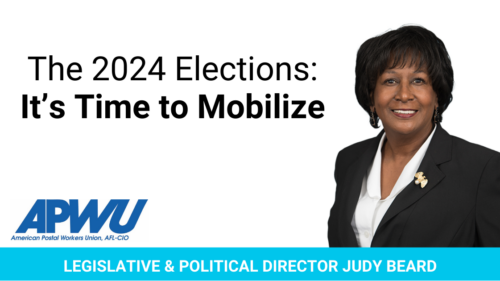
The 2024 Elections: It’s Time to Mobilize
August 26, 2024Legislative Director Judy Beard urges members to get involved this election season, check their voter registration, and make a plan to vote.
magazineLegislative and PoliticalJudy Beard
You have probably heard that democracy is on the ballot this November in the 2024 elections. Many of you may wonder what exactly this means. Put simply, the outcomes of the upcoming elections will determine the future of our nation, our jobs, and our lives. We will have choices to make up and down the ballot. Are we looking to expand rights and freedoms for all Americans, or place limitations? Are we looking to unite through truth and honesty, or divide through lies and deceit? Are we looking to go forward into a future marked by progress and hope, or one marked by hatred and despair, where the top one percent get richer, leaving the rest of us behind? These are the questions we must ask ourselves as we go to mark our ballots this election season.
It is absolutely critical that we vote not only in the presidential election at the top of the ticket, but all the way down the ballot. Governors, state legislatures, city councils, school boards, local judges, police chiefs, and more all shape the policies that govern your life. Some states and localities have various ballot initiatives and referenda to vote on, which allow you to have a direct say in policy. Decisions at the state and local level can affect you and your family’s lives just as much as federal elections. So, remember to vote on these ballot measures and in these elections as well!
Remember that your vote is your voice. These elections will be decided, in large part, by the nearly half of eligible voters who do not exercise their most fundamental right in our democracy. This right was not given to us, it was fought for and won through years of struggle. That is why we must all encourage our family, friends, and community to mobilize around building a better future this November. In order to do this, we need to educate everyone about what’s at stake and how to make our voices heard. Here is a checklist to ensure nothing is missed when making your plan to vote:
Determine your method of voting: early, absentee, by-mail, in-person
Locate your polling place
Get a ride to the polls
Schedule a time to vote
Check potential ID requirements
Check who is on your ballot
Volunteer to be a poll worker
Please visit our website at apwu.org/2024-elections to hear from your fellow APWU members on the importance of voting and checking your voter registration status. On that page you will also find links to help you make your plan to vote, find your current representatives, and much more. If you have any questions about how to make your plan to vote this November, please feel free to contact the Legislative and Political Department by email at legislative@apwu.org or phone at 202-842-4211. We are a resource to help every single APWU member, as well as their family and friends, exercise their hard-fought right to vote this November!
The 2024 Elections: It’s Time to Mobilize0
Read More....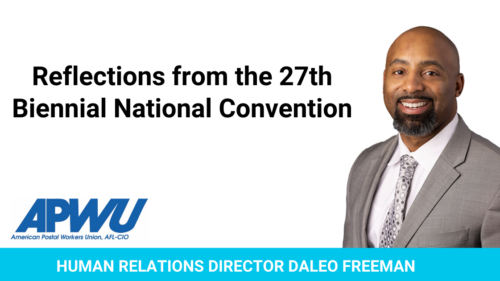
Reflections from the 27th Biennial National Convention
August 26, 2024Human Relations Director Daleo Freeman shares takeaways from the 27th Biennial National Convention, and more of what’s to come from the Human Relations Department.
magazineHuman RelationsDaleo Freeman
Defined Progress
The APWU Constitution and Bylaws mandates the Human Relations Department’s role in fostering equal opportunity, community service, and supporting our members in various capacities. We stand on the shoulders of excellent leaders who championed our causes. Their legacy propels us forward as we continue to uphold these principles. The Pre-Convention Workshops and the National Convention were a major success, as delegates from across the country descended upon Detroit to attend over a week’s worth of great training and spirited debates about all sorts of issues from the protection of our constitutional rights to the continued solidarity for all in the labor movement. It was an honor to participate and witness a momentous event that will shape and mold the future of our union for years to come. Thanks to everyone that attended. We hope that everyone has returned to their respective area that much more energized, mobilized, and organized than ever before.
Staying In Motion
In the spirit of progress, the Human Relations Department remains committed to staying in motion. Communication is key as we work to address members’ needs across the nation. We’re expanding our reach with a network of local and state Human Relations representatives, ensuring that support is accessible wherever it’s needed. By leveraging resources and knowledge, we empower our members and strengthen our collective resolve.
We extend our heartfelt gratitude to our dedicated Regional Resource Assistants (RRAs) for their unwavering commitment and tireless efforts in completing training programs related to the Office of Workers’ Compensation Programs (OWCP) and on-the-job injuries. Their expertise and dedication equip them with the knowledge and tools needed to provide invaluable support to locals nationwide, ensuring proper advice and effective assistance to workers within the APWU family. Through formal training and certification processes provided by the Department of Labor (DOL), our RRAs stand ready to deliver comprehensive training and guidance on these critical issues. We are immensely grateful for their invaluable contributions to our union’s mission and vision. For a listing of our current RRAs please visit, apwu.org/regional-resource-assistants.
Coalitions Are Key
Another key to our success lies in building and fortifying coalitions. By uniting with diverse interest groups, we amplify our impact and advocate for meaningful change. Please visit, apwu.org/coalitions to learn more about our coalitions.
Furthermore, the Human Relations Department has demonstrated a steadfast commitment to advocating for human rights by attending monthly meetings and partnering with the Civil, Human and Women’s Rights Director (CHWR Director) at the AFL-CIO and affiliate union directors focusing on civil and human rights. These meetings serve as a platform for discussing and advancing crucial issues related to human rights, ensuring that our union remains at the forefront of advocacy efforts. Through collaboration and dialogue, we continue to amplify our collective voice in support of equality, justice, and dignity for all.
We extend our deepest gratitude to Robert La Foe, our dedicated Veteran Guard and Reserve Information Specialist (VGRIS), for his unwavering advocacy and steadfast support of veteran benefits and awareness within our union. Robert’s tireless efforts ensure that our veteran members receive the recognition, support, and benefits they rightfully deserve for their service to our country. His commitment to raising awareness and championing the rights of veterans embodies the spirit of solidarity and inclusivity within the APWU family. We are profoundly grateful for Robert’s leadership and dedication to serving those who have served us all. Please join our veteran coalition efforts by logging into your Member Profile and adding your veteran designation and the branch you served to stay connected to important veteran news and benefits.
Together, we address common concerns and demonstrate the integral role of the labor movement in everyday life. Through collaboration, we harness the strength of solidarity and advance our shared goals. ■
Reflections from the 27th Biennial National Convention0
Read More....