
24 Things You Need to Know From the 2026 Death on the Job Report
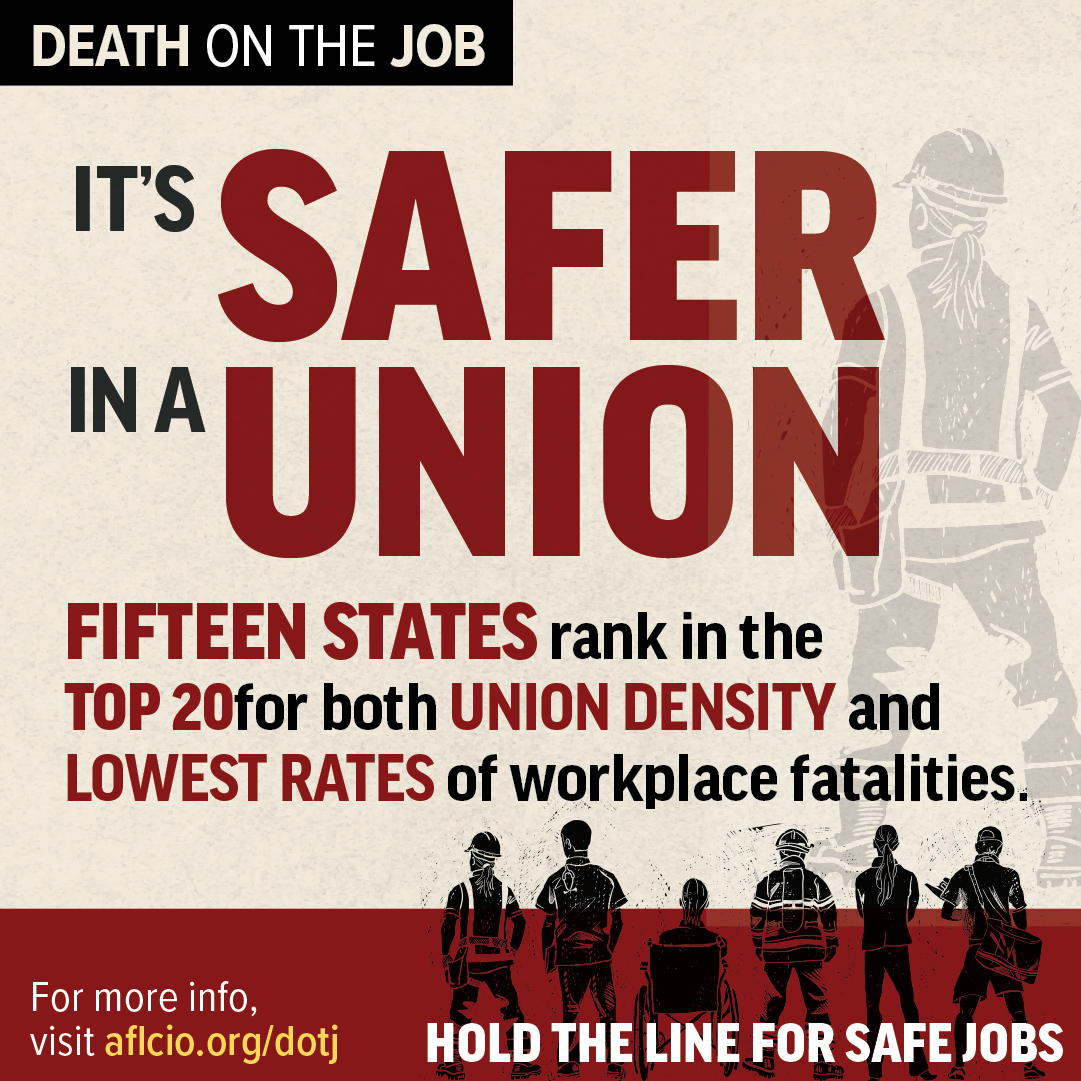
Workers are dying and being injured on the job as the Trump administration cuts essential funding and staffing and directs resources away from the agencies and policies that protect workers and hold employers accountable, according to a new report released today by the AFL-CIO.
Ahead of Workers Memorial Day on April 28, the AFL-CIO released its 35th annual “Death on the Job: The Toll of Neglect” report, a comprehensive analysis of the state of workers’ health and safety at the national and state levels.
“Every worker should be able to go home safe and healthy at the end of their shift—but 55 years after the founding of the Occupational Safety and Health Administration, that fundamental right is in danger,” said AFL-CIO President Liz Shuler. “From the dismantling of critical federal agencies and laws to the expansion of unregulated, untested AI technology, the protections that workers fought and died for are under serious threat. The labor movement refuses to go backward. More than 5 decades after a Republican signed the landmark Occupational Safety and Health Act into law, we urge all members of Congress—from both sides of the aisle—to join us in this fight.”
“It is a disgrace that in 2026, being Black, Latino or an immigrant can still be a death sentence on the jobsite,” said AFL-CIO Secretary-Treasurer Fred Redmond. “Our new report makes it terrifyingly clear that the Trump administration’s anti-DEI, mass deportation agenda will only make this crisis worse. When workers are afraid that reporting threats to their safety could result in their work permits being revoked and their families being ripped apart, and when employers fear that reporting workplace data will hurt their bottom line, we are all less safe: workers of color and white workers, immigrant workers and U.S.-born workers. We must fight the Trump administration’s attacks on communities of color like our fellow workers’ lives are on the line—because they are.”
Here are 24 things you need to know from the report:
- In 2024, More than 380 workers died each day from hazardous working conditions.
- 5,070 workers were killed on the job in the United States.
- An estimated 135,000 workers died from occupational diseases.
- The overall job fatality rate decreased to 3.3 per 100,000 workers.
- Workers of color die on the job at a higher rate: Black (3.4 per 100,000 workers) and Latino (4.3) worker job fatality rates are disproportionate compared with all other workers.
- An estimated 530 workers died from heat on the job, but both fatal and nonfatal data are an undercount of the real problem.
- Workplace homicides continue to be a significant problem, increasing by 3% since 2023; workplace suicides decreased 6.4% from 2023.
- Separately, unintentional overdoses at work decreased 21% from 2023 to 2024, due to increased attention paid to and efforts to combat the opioid crisis.
- Employers reported nearly 3.1 million work-related injuries and illnesses, a decrease from the previous year.
- The rate of serious workplace violence injuries has decreased to 2.6 per 10,000 workers.
- Musculoskeletal disorders from repetitive motion injuries continue to be a major problem, accounting for approximately 32% of all serious work-related injuries and illnesses in private industry.
- Underreporting of all workplace injuries and illnesses is widespread—the true toll of work-related injuries and illnesses is estimated to be 5.0 million to 7.5 million each year in private industry.
- Chemical exposures continue to plague working people, leading to debilitating, life-threatening diseases that are preventable.
- The cost of job injuries and illnesses is enormous, estimated at $177 billion to $354 billion a year—an undercount of the real impact on society, families and communities.
- States with the highest fatality rates in 2024 were: Wyoming (13.9 per 100,000 workers), Mississippi (8.0), Alaska (7.1), North Dakota (6.8) and Arkansas (6.2).
- Industries with the highest fatality rates in 2024 were: Agriculture, forestry, and fishing and hunting (20.9 per 100,000 workers), mining, quarrying, and oil and gas extraction (13.8), transportation and warehousing (12.2), construction (9.2) and wholesale trade (4.6).
- The job fatality rate increased in the leisure and hospitality industry from 2.3 to 2.4 per 100,000 workers and in the government sector from 1.8 to 2.0 per 100,000 workers.
- In 2024, more than one-third of workplace fatalities occurred among workers ages 55 and older.
- Workers 65 and older have nearly three times the risk of dying on the job as other workers, with a job fatality rate of 9.1 per 100,000 workers.
- The rate of young worker deaths increased from 1.3 in 2022 to 1.9 in 2023 and then to 2.7 in 2024—nearly doubling the rate from 2020.
- Many children, mostly migrants, have become the focus of stark exploitation, working in dangerous conditions.
- Federal OSHA has the lowest number of inspectors in the history of the agency—only enough to now inspect workplaces once every 191 years—and state OSHA plans have one fewer inspector compared with FY 2024. By comparison, it would have taken federal OSHA 84 years to inspect each workplaces once in 1991, as written in our first report published in 1992. There are 1,651 inspectors (618 federal and 1,033 state) to inspect the 12 million workplaces under the Occupational Safety and Health Act’s jurisdiction, covering 155 million workers—a workforce that keeps growing while OSHA staff numbers do not. In 1991, there were 1,953 federal and state inspectors to cover 6.5 million workplaces and 107 million workers under OSHA’s jurisdiction. There is one inspector for every 93,877 workers. By comparison, there was one inspector for every 54,952 workers in 1991. The current OSHA budget amounts to $3.85 available to protect each worker. In 1991, the OSHA budget amounted to $6.53 per worker after inflation adjustments.
- Penalties in FY 2025 still are too weak: The average penalty for a serious violation was $4,678 for federal OSHA. The median penalty for killing a worker was $16,550 for federal OSHA.
- Only 144 worker death cases have been criminally prosecuted under the Occupational Safety and Health Act since 1970.p
Read the full report.